Written by Steven Shapiro
President, Marketplace at HealthCare.com
Compare ACA and Private Plans That Fit Your Needs
You will be taken to

to finish your submission.
Key Takeaways
- If the Marketplace paid more toward your premiums than you end up qualifying for, you pay back the difference when you file your federal taxes.
- Starting with 2026 coverage, there is no cap on what you pay back. The One Big Beautiful Bill Act, signed July 4, 2025, removed the old limits. This first hits tax returns filed in 2027.
- Under current law, if your income ends up above 400% of the federal poverty level for 2026 or 2027 coverage, you get no credit at all and must repay all the advance credit you got.
- The enhanced subsidies expired at the end of 2025. As of October 20, 2026, no extension has become law.
- Report income and household changes to the Marketplace right away, and estimate your 2027 income carefully during open enrollment, which starts November 1, 2026.
Yes, you may have to pay back some or all of your premium tax credit. If you used more of the credit during the year than your final income allows, the extra is called an excess advance premium tax credit. You repay it on your tax return.
Excess advance premium tax credit repayment used to be capped for most people. That changed starting with the 2026 tax year. Now a wrong income guess can cost you the full difference.
How Do Advance Premium Tax Credits Work?
The premium tax credit helps pay for a health plan you buy through the ACA marketplace. You can take it in advance. The Marketplace sends the money straight to your insurer each month, so your premium bill is lower. This is called the advance premium tax credit, or APTC.
The catch is that the credit is based on your income for the whole year. When you sign up, the Marketplace only has your estimate. Your real number is not known until you do your taxes.
What Happens at Tax Time: Form 8962
At tax time, you compare the credit you used with the credit you actually qualify for. This is called reconciling. Your Marketplace sends you Form 1095-A early in the year. It shows your premiums and how much APTC was paid. You use it to fill out IRS Form 8962, which you file with your tax return.
- If you used too much: the extra is added to your tax bill or taken out of your refund.
- If you used too little: you get the difference back as a bigger refund or a lower tax bill.
You must file a federal return and Form 8962 if APTC was paid for you, even if you would not normally file. If you skip it, the IRS says you will not be able to get APTC in future years. Our guide to the 1095-A tax form explains the paperwork.
Why Do People Owe Money Back?
Most repayments come from one of these:
- Your income went up. A raise, a new job, a bonus, side work or a good year in your business can all push your income past your estimate.
- Your household changed. Getting married or divorced, having a baby, or adding or losing a dependent on your tax return changes your household size. That changes your credit.
- You got other coverage. If you enrolled in Medicaid or job-based coverage, or were offered affordable job-based coverage, but kept taking APTC, you may owe some back.
The credit is based on your modified adjusted gross income, which is not the same as your take-home pay. See what counts in our guide to what is considered income for health care tax credits.
The Big Change: No More Repayment Caps
For tax years before 2026, most people with income under 400% of the federal poverty level had a cap on what they had to repay. The cap depended on income and filing status. (For 2020 only, excess credits did not have to be repaid at all.)
Section 71305 of the One Big Beautiful Bill Act (Public Law 119-21) removed those caps. The change applies to tax years that start after December 31, 2025. The IRS puts it simply: “There is no repayment cap for tax years after 2025.” So for 2026 coverage, you repay the full excess when you file in 2027.
| Income (% of federal poverty level) | Most you repaid for 2025 (single) | Most you repaid for 2025 (all other filers) | 2026 and later |
|---|---|---|---|
| Under 200% | $375 | $750 | Full excess, no cap |
| 200% to under 300% | $975 | $1,950 | Full excess, no cap |
| 300% to under 400% | $1,625 | $3,250 | Full excess, no cap |
| 400% or more | No cap, repay all | No cap, repay all | No cap, repay all |
Source: IRS, 2025 Instructions for Form 8962, Table 5; IRS, Questions and Answers on the Premium Tax Credit; Public Law 119-21, Section 71305. The 2025 caps apply to tax returns for 2025 coverage filed in 2026.
Example: How Much Could You Owe?
These numbers are illustrative only. The plan price is made up for this example. It uses the 2026 shares of income from IRS Revenue Procedure 2025-25 and the 2025 poverty guideline of $15,650 for one person, which applies to 2026 coverage. Your premiums, credit and taxes will be different.
Maria is single and lives in one of the 48 contiguous states. She buys the benchmark silver plan in her area for 2026. In this example, it costs $600 a month, or $7,200 for the year. She estimates she will earn $40,000, which is about 256% of the poverty level. At that income, she is expected to pay about 8.61% of her income, or about $3,444, for the year. So her Marketplace pays about $313 a month toward her premium, or about $3,756 for the year.
Then she picks up extra work and does not report it to the Marketplace. Her actual 2026 income comes in at $56,000, or about 358% of the poverty level. At that income, she is expected to pay 9.96% of her income, or about $5,578. When she fills out Form 8962, her credit for the year works out to only about $1,622 ($7,200 minus $5,578).
- Credit paid in advance: about $3,756
- Credit she qualifies for: about $1,622
- Excess she must repay: about $2,134
If the 2025 caps still applied, a single filer in her income range would have repaid no more than $1,625. For 2026, Maria repays the full $2,134 or so.
Now say Maria earns $65,000 instead. That is above 400% of the poverty level for a single person ($62,600 for 2026 coverage). She qualifies for no credit, so she repays all $3,756 or so. That part is not new. Apart from the one-year 2020 pause, there was never a cap above 400%.
Is the 400% Subsidy Cliff Back?
Yes. From 2021 through 2025, the enhanced subsidies let people above 400% of the poverty level get help. Those enhanced credits expired at the end of 2025. The House passed a three-year extension (H.R. 1834) on January 8, 2026, by a vote of 230 to 196. Congress.gov shows it was placed on the Senate calendar in February 2026, with no Senate vote. As of October 20, 2026, no extension has become law.
That means the cliff applies for 2026. Unless Congress changes the law, it also applies for 2027. If your household income is even $1 over 400%, you get no credit for the year.
- 2026 coverage (uses 2025 poverty guidelines): $62,600 for one person, $128,600 for a family of four.
- 2027 coverage (uses 2026 poverty guidelines): $63,840 for one person, $132,000 for a family of four.
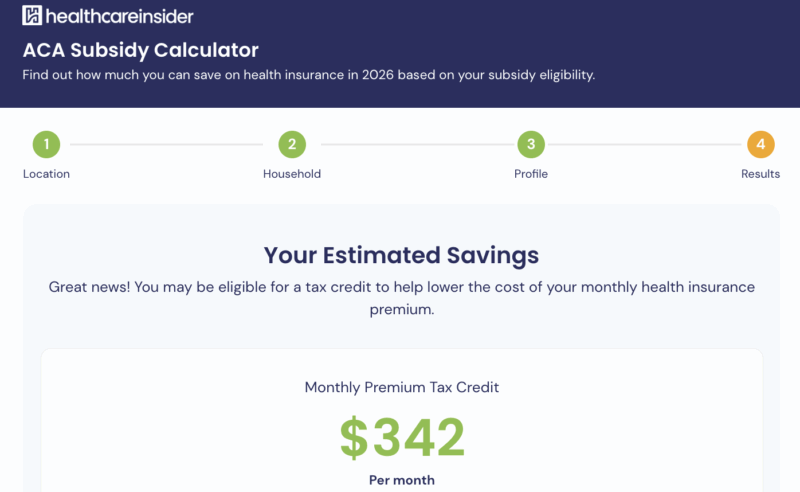
These figures are for the 48 contiguous states and D.C. They are higher in Alaska and Hawaii. To see where you land for 2027, try our ACA subsidy calculator or read whether you will qualify for an ACA subsidy in 2027.
What You Pay for a Benchmark Plan in 2027
Your credit is set so you pay a certain share of your income for the benchmark plan in your area. That is the second-lowest-cost silver plan. Here are the 2027 shares.
| Household income (% of federal poverty level) | Share of income you pay for the benchmark plan in 2027 |
|---|---|
| Under 133% | 2.15% |
| 133% to under 150% | 3.23% to 4.3% |
| 150% to under 200% | 4.3% to 6.78% |
| 200% to under 250% | 6.78% to 8.66% |
| 250% to under 300% | 8.66% to 10.22% |
| 300% to 400% | 10.22% |
| Over 400% | No credit |
Source: IRS Revenue Procedure 2026-26. Where a range shows two numbers, the share rises with income within that range. For 2026, the top share is 9.96% (IRS Revenue Procedure 2025-25).
How to Avoid a Big Tax Bill for 2027
Open enrollment for 2027 coverage runs November 1, 2026, to January 15, 2027, on HealthCare.gov. Enroll by December 15 for coverage that starts January 1. State marketplaces may have different dates. See our guide to 2027 open enrollment dates.
Use that window to set yourself up well:
- Estimate your 2027 income carefully. Start with your most recent tax return. Add raises, bonuses, side work and any expected changes. If your income swings, lean toward the high side.
- Report changes right away. Update your Marketplace account when your income or household changes. The IRS says reporting changes as they happen helps keep your advance credit close to the right amount.
- Take less APTC in advance. You can use all, some or none of your credit each month. Taking less raises your monthly premium. But it lowers the chance you owe money back. If you take too little, you get the rest at tax time.
- Watch the 400% line. If you are close to it, small things matter. Contributions to a health savings account, or deductible contributions to a traditional IRA, may lower the income used for your credit.
Taxes like these can get complicated. If you are self-employed, close to the 400% line or had big household changes, consider talking with a tax professional.
What If You Can’t Pay Back the Credit?
Your repayment becomes part of your federal tax bill. If you cannot pay it all, the IRS offers payment plans:
- Short-term plan: Pay within 180 days. You can apply online if you owe less than $100,000 in total tax, penalties and interest. There is no setup fee.
- Long-term plan: Pay monthly. You can apply online if you owe $50,000 or less and have filed all required returns. Online setup fees are $29 with automatic bank payments or $69 with other payment methods. Low-income taxpayers may get the fee waived or reduced.
Interest and some penalties keep adding up until you pay in full. File on time even if you cannot pay, and pay what you can as soon as you can.
See plans in your area and what you would pay after any tax credit.
A friendly team of licensed insurance agents can help you pick a plan and set your tax credit before your deadline.
Frequently Asked Questions
Do I have to pay back my premium tax credit?
Only if you used more than you qualify for. If your actual income was higher than your estimate, or your household changed, you repay the extra on your tax return. If you used less than you qualify for, you get money back instead.
Is there still a cap on premium tax credit repayment?
Not for 2026 or later. Caps applied for most people for tax years before 2026. Starting with 2026 coverage, you repay the full excess when you file in 2027.
When does the no-cap rule start?
It applies to tax years that start after December 31, 2025. Your 2025 return, filed in 2026, still uses the old caps. Your 2026 return, filed in 2027, does not.
What happens if my income goes over 400% of the poverty level?
You qualify for no premium tax credit for that year and must repay all the advance credit you received. For 2027 coverage, 400% is $63,840 for one person and $132,000 for a family of four in the 48 contiguous states and D.C.
This article is for general information only and is not tax or legal advice. Your result depends on your final household income and family size for the year.
Sources
- Public Law 119-21 (One Big Beautiful Bill Act), Section 71305
- IRS, Questions and Answers on the Premium Tax Credit
- IRS, Fact Sheet FS-2025-10, Updates to Questions and Answers About the Premium Tax Credit
- IRS, 2025 Instructions for Form 8962
- IRS, Revenue Procedure 2026-26 (2027 applicable percentages)
- IRS, Internal Revenue Bulletin 2025-32, Revenue Procedure 2025-25 (2026 applicable percentages)
- Congress.gov, H.R. 1834 Actions (119th Congress)
- IRS, Payment Plans and Installment Agreements
- HealthCare.gov, Marketplace Plan With the Premium Tax Credit
- HealthCare.gov, How to Save Money on Monthly Health Insurance Premiums
- HealthCare.gov, Federal Poverty Level (FPL)
- HealthCare.gov, Dates and Deadlines
- HHS ASPE, 2026 Poverty Guidelines
- KFF, What’s the Most I Would Have to Repay the IRS?
- healthinsurance.org, If My Income Changes and My Premium Subsidy Is Too Big, Will I Have to Repay It?
- ASTHO, ACA Enhanced Premium Tax Credits: Legislative Developments in 2025 and 2026
We want to help you make educated healthcare decisions. While this post may have links to lead generation forms, this won’t influence our writing. We adhere to strict editorial standards to provide the most accurate and unbiased information.


Prescription Savings Made Simple
Save at over 80,000 pharmacies nationwide with CareCard.
Get Started